Galileo, a vatting of different styles of Ardbeg laid down in 1999, is a combination of spirits that have been matured in ex-Marsala wine casks or in ex-bourbon casks. Together they create a sweet, smokey whiskey. The few thousand cases of the 12 year old whiskey made available are being picked up quickly and the space experiment that it was named after is going strong.
The experiment will help explain the nature of "terpenes" compounds and will provide Ardbeg with information on new chemical building blocks in its own flavor spectrum.
Having recently become available, Galileo is restricted to two bottles per person (but already out of stock on the Ardbeg site). Bottled at a strength of 49% it is non chill-filtered for extra texture and mouth feel.
Tasting Notes Aroma: A burst of intense smoky fruit escapes into the atmosphere. Add water and breathe in toasted vanilla, sizzling cinnamon and warm hazelnut. Taste: An explosion of crackling peat ignites flavour explosions. Tangy lemon and lime juice, spiced toffee, followed by smooth buttermilk, bananas and currants. Smoke brims with creamy cappuccino and toasted marshmallows. Finish: Long and smoky with tarry espresso
above: The Ardbeg Rocket Tour kicked off in Chicago on May 3, 2012 and will stop in 22 states in 28 weeks. Tour stops include key U.S. landmarks in states including California, Texas, New York and Florida. An Ardbeg Brand Ambassador will be on board the tour to educate consumers on the experiment, the brand, and where legal, to sample Ardbeg, recently rated by The Whisky Bible as the "Best Single Malt Scotch – 10 Years and Under."
Artist and Designer Frank Tjepkema (aka Tjep.), has a fun series of solid sterling silver rings based on the pixelated alien invaders in Taito's classic arcade game, Space Invaders.
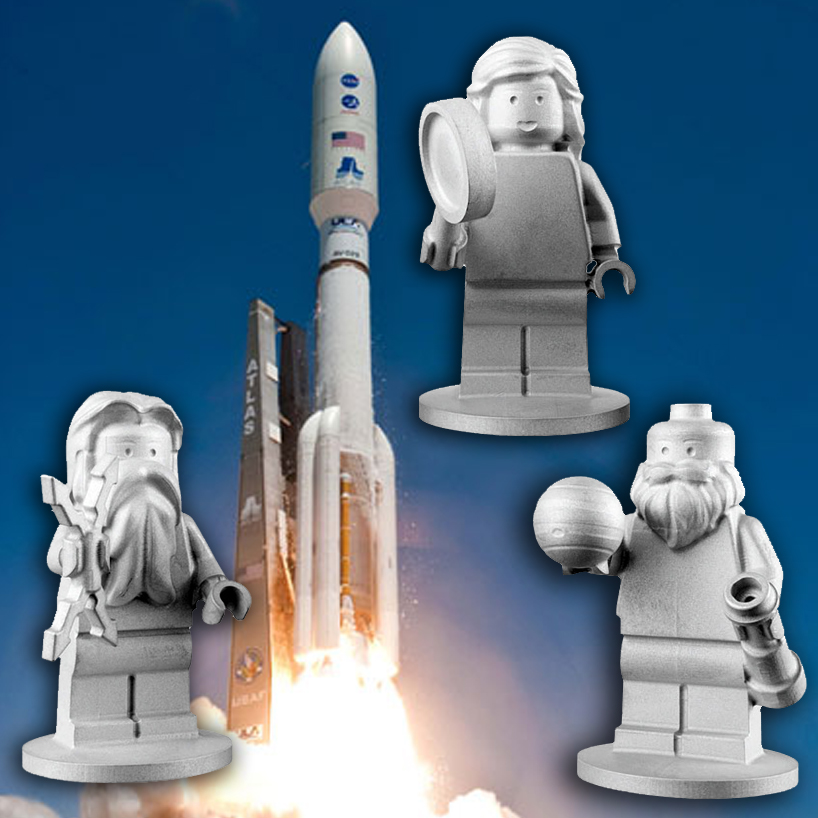
Okay, so they weren't really stowaways, but certainly not your expected passengers. The special cargo - three 1.5" tall aluminum LEGO® Minifigs- left earth on NASA's Juno deep-space probe on August 5th for a five-year mission to Jupiter as part of NASA and LEGO's Bricks In Space program, a joint partnership to inspire children and broaden awareness of the importance of planetary research.
above: the Lego Minifigures affixed to the Juno probe before take-off.
In Greek and Roman mythology, Jupiter drew a veil of clouds around himself to hide his mischief. From Mount Olympus, Juno was able to peer through the clouds and reveal Jupiter's true nature. Juno holds a magnifying glass to signify her search for the truth, while her husband holds a lightning bolt:
The third LEGO crew member is Galileo Galilei, who made several important discoveries about Jupiter, including the four largest satellites of Jupiter (named the Galilean moons in his honor). Of course, the miniature Galileo has his telescope with him on the journey:
The LEGO Minifigures will help get attention for Juno’s mission to improve understanding of our solar system’s beginnings by revealing the origin and evolution of Jupiter.
above: click to enlarge and get a better look at the Juno Spacecraft
The inclusion of the three mini-statues, or figurines, is part of a joint outreach and educational program developed as part of the partnership between NASA and the LEGO Group to inspire children to explore science, technology, engineering and mathematics.
Video of the August 5th launch (on which the minifigs were affixed to the space probe):
The spacecraft is expected to arrive at Jupiter in 2016. The mission will investigate the gas giant's origins, structure, atmosphere and magnetosphere. Juno's color camera will provide close-up images of Jupiter, including the first detailed glimpse of the planet's poles.
50 sets of rings known as SWR-50th Anniversary Collection were inspired by the 50th anniversary of first human space flight which took place on April 12, 1961. The collection will be created in cooperation with jewelry designers from all over the world.
On May 20, 7:24 (MDT) the first set of space wedding rings were sent in space in a suborbital sounding rocket in New Mexico, USA. The flight went smoothly and the professionally secured package containing one set of wedding rings and some gold reached the space and came to Earth sound and safe.
CREDIT: Bob Martin/KRQE Television
The first 10 sets of rings available now will be made from the gold that was flown in space in the same capsule as the first Space Wedding Rings SWR-001.
Each set of Space Wedding Rings will be assigned a unique serial number and engraved with the SpaceWed logo. The rings will be sold in custom designed, space-themed packaging and will include a Certificate of Space Flight, as well as documentation of the rocket launch.
From the beginning of June you will be able to place an ORDER for the RINGS AVAILABLE NOW or PRE-ORDER the rings which will go in space in the next flight by the end of 2011.
If you're a fan of vintage travel posters and George Lucas' Star Wars movies, like illustrator Steve Thomas, these Star Wars Travel Posters will quickly become amongst your favorites. Illustrated in the style of mid- 20th century travel posters, they advertise the merits of Star Wars planets, places and transportation.
above: detail of the Millenium Falcon from one of the posters
Although he created these a few years ago, they were recently brought to my attention by Dvice. They have yet to be produced, but he's working on it.
About the artist:
Steve Thomas has been working for newspapers churning out graphics and illustrations for more than 10 years. When not at his day job, he tries to come up with new and interesting ideas for illustrations. His love for vintage poster, propaganda and product art from the early 20th century and an interest in retro-futuristic art from the mid-20th has led him to create some great poster art, many of which you can see in his online portfolio or purchase on Zazzle.
Steve has also created marketing and advertising art for various companies, from label expo organizers to architecture firms. Some of his clients have included the Tarsus Group, Meteora, the Alderac Entertainment Group (Fantasy Flight Games), Synaptic Overload Games and ICON magazine.
Now, I don't know how it tastes, but Sapporo has released a brew whose barleycorn was cultivated during a five month space mission. That's right, a beer brewed in zero gravity. Sapporo intends to sell limited quantities of the space brew with proceeds going to a charitable science program for Japanese children. CNET says there will be a lottery in which 250 winners will be able to purchase the brew, the price of which will be $115.00 a six-pack. Why they did this as well as how is explained in detail further on in this post.
Product specs: Name: SAPPORO Space Barley Material: Malt, hops Content features: 100% use of the the seedlings of barleycorn that traveled the space for five months Alcoholic content: 5.5% Volume/Number per package: 330ml in a one-way bottle Design: A chic design with Navy blue graduation representing the space set with stars, featuring the product name like a shooting star. Barley is an English word. Manufacturing plant: Nasu Breweries, Sapporo Breweries The information below is from The Sapporo Bioresources Research & Development Department: SAPPORO Space Barley In collaboration with Dr. Sugimoto, Associate Professor, (Speciality" Cytomolecular Biochemistry) of the Research Institute for Bioresources, Okayama University (Kurashiki City, "Okayama University) and the Institute of Biomedical Problems of the Russian Academy of Sciences", Sapporo Breweries, Ltd. (Head office: Tokyo; President: Masaru Fukunaga) test brewed the first-in-the world beer brewed from the seedlings of barleycorn that traveled the space, "SAPPORO Space Barley."
Most of the only 100 litters of brewed beer will be used for experiments, but Sapporo would like to offer part of the beer for tasting events to be held at six breweries in Japan (Hokkaido, Sendai, Nasu, Chiba, Shizuoka and Shinkyushu,) and is inviting 60 persons (30 pairs) of customers.
The beer was brewed as part of the joint research with Okayama University conducted to exploit possibilities of barleycorn for beer in space, "Studies of Impact of Extreme Environmental Stresses on Barley" and uses 100% of the "seedlings of barleycorn that traveled the space."
Regarding the malt used for the beer, seeds of "Haruna Nijo," beer barley developed by Sapporo Breweries that stayed in space for five months in the Russian Research Modules of the International Space Station were brought back to earth, cultivated at their experimental field of Bioresearch and Development Department at our Gunma Plant and successfully harvested in this past May. The company plans to offer opportunities for the invited guests to taste "Space Barley," and be awarded the chance to taste the brew and tour the breweries. Next year, in addition to this series of events, they also plan to hold a "space class" and an event to "roast and taste barley tea" for local children at these breweries by taking advantage of the "seedlings of barleycorn that traveled the space" still under cultivation. Sapporo Breweries hopes to contribute to awareness-raising about the space as well as the advancement of space science and children's education and continue to pursue possibilities of food and drink in space.
History of "space barley" April 2006 Haruna Nijo malting barley developed by Sapporo Breweries through collaborative research with Okayama University and the Russian Academy of Sciences was kept aboard the Zvezda Service Module, a component of the International Space Station (ISS), for five months (first-generation "space barley").
April 2007 Seeded the first-generation "space barley".
November 2007 Harvested the second-generation "space barley"; seeded the second-generation "space barley".
May 2008 Harvested the third-generation "space barley".
October 2008 Trial brewing of the world's first beer made from the third-generation "space barley".
November 2008 Seeded the third-generation "space barley".
January 2009 Tasting events held at breweries nationwide for beer made from the third-generation "space barley".
May 2009 Harvested the fourth-generation "space barley".
August 2009 Hop seeds from Furano, Hokkaido launched into space.
September 2009 Tasting events held at five breweries nationwide for barley tea made from "space barley".
November 2009 Seeded the fourth-generation "space barley".
December 2009 Applications accepted to buy SAPPORO Space Barley-the beer brewed from the fourth-generation "space barley".
Sapporo Breweries Limited (PINK:SOOBF) was established in 1949 and is the foremost brewing company in Japan with a 120-year brewing history.
All information and images courtesy of Sapporo Breweries Ltd., Public Relations Section