Showing posts with label corian. Show all posts

Domenico de Palo's Sexy Sliver of A Sink. The Silenzio For Antonio Lupi.


Silenzio is a Corian washbasin that is a sexy sliver of Industrial Design. The concept behind Silenzio is to offer only the functionality and sculptural mark of a washbasin, allowing it to be perfectly integrated into the wall, dominated by the atmospheric elements of cut and light.


The unmistakable signature of Domenico de Palo is even more evident in this washbasin which is able to blend into the surface onto which it is installed. Silenzio appears to come out of the wall, giving it a life and shape.


The Silenzio washbasin is realized in Corian and, after it has been positioned (with puttying and plastering), it can be painted just like the rest of the wall, so that it disappears into the same. Silenzio can be described as a “nude” washbasin to be dressed in clothing that can be changed and updated with different finishes.


Silenzio offers an unconventional reinterpretation of the bathroom. It is a fusion between a functional object of the past and a newly invented element of the present.


Antonio Lupi

Rabih Hage Turns Leftover Dupont Corian Into A Modern Furniture Collection.


To launch the new colors of Dupont Corian® for 2012, Corian® presented an international exhibition at Milan Design Week titled “Corian® Colour Evolution.” As part of the exhibition, UK designer Rabih Hage proposed original products made with 'leftovers' from the new colours of DuPont™ Corian®, alone or in combination with other materials.


The Leftover Collection

The focus of Rabih’s four designs is on the use of leftover material and its reuse, treating the off-cuts and discarded planks used in the building of furniture as a “noble material”, reused in new luxurious furniture pieces.

“Leftover Table” desk or dining table:


“I have always been fascinated by unused material or discarded cuts of stone, wood or metal whether chea or expensive. Reusing these materials as a luxury product and treating the off-cuts as something precious is my real motivation. Especially, DuPont™ Corian®, which I regard as a luxurious material. I like the imperfection in patinated antique pieces, and the patina of time is something impossible to imitate, therefore, authentic. To get closer to this authenticity I regard the random layering of off-cuts as a noble design gesture and authentic in the building of my new designs for “Corian® Colour Evolution”. Imperfection is beauty; a discarded material is as noble and precious as a newly polished stone,” explains Rabih Hage.

"Colour Console” bookshelf:


“Colour Chair” desk chair:


“Leftover Armchair” visitors chair:


Rabih Hage, Design by Rabih Hage, Fabrication by Clarendon Fabrications, photos by Leo Torri for DuPont™ Corian®


About the designer:


Rabih Hage is an Architect, Designer, Curator and owner of Rabih Hage Design Studio and Rabih Hage Gallery. Rabih creates beautiful interiors and architecture with a cutting edge and creative vision. Rabih Hage contributes frequently to various publications and his work has been recognised with numerous awards including the Andrew Martin International Interior Designer of the Year in 2011.

Since 2001, Rabih has dedicated himself to contemporary design, architecture and creative collaborations, which lead him to discovering new talents and pioneering design and design-art. With a forward thinking approach Rabih Hage curates cutting edge furniture and works from up-and-coming designers and established talents, whilst directing his creative team at his Design Studio working on international interior and architecture projects with a unique vision. In 2008 Rabih Hage created the Rough Luxe Hotel which triggered a worldwide movement in design. Hage has established himself as a reference in new hotel concepts and developments, working with international hoteliers and developers, most recently completing the front or house of the Radisson Edwardian Guildford Hotel.

DuPont Corian®

Z. Island. A Kitchen Collaboration Between Zaha Hadid, Ernestomeda and Corian.


The multi-sensorial kitchen


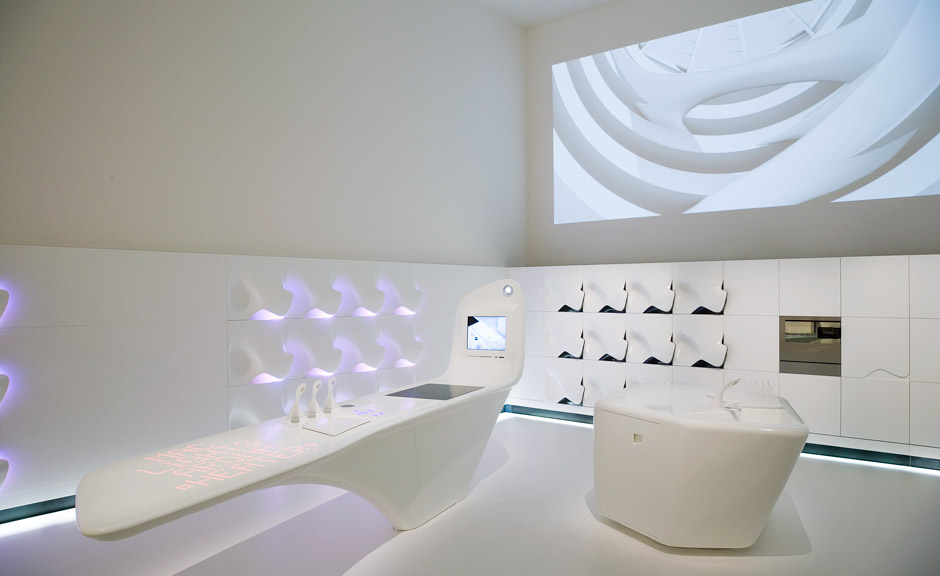
"Z.Island" is not simply a project created in order to astonish people and make them talk. The kitchen area conceived by architect Zaha Hadid in collaboration with Ernestomeda and DuPont brings with it concrete innovations that will be useful for future production and that involve the processing of the materials, the structural organisation and the integration of advanced technologies.


Malleable materials, fluid environment
Corian®, the raw material used for the creation, is an exceptionally malleable element that is perfect for meeting the creative requirements of an architect renowned for the complexity of her designs. No longer restricted to isolated elements, such as the worktops or sinks, Corian® has now been used to create an entire kitchen structure (split into two blocks, which are at the same time functional, compact and sleek) and an extensive modular range of cupboards and panelling. The surface is translucent, smooth and fluid, and is as pleasant to look at as it is to touch.


Sophisticated instruments
The cooking island (with hob and hotplate) is extended and curves along the right hand edge; the washing island (with sink, draining area and completely hidden built-in dishwasher) is hexagonal and compact.


The horizontal surface of the former is provided with a scrolling LED script, while there is also a spotlight, an LCD screen and, slightly lower down, an mp3 player, two USB ports and a CD or DVD player. The central working area houses an induction hob, a food preparation area and a hotplate built into the Corian® worktop. Finally, from here it is possible to release special fragrances through three aromatic scent dispensers to permeate throughout the entire kitchen area.

Wall panelling


Complementary wall-mounted cupboards and wall panelling are available: the former made using shaped wavy doors in Corian®, set into an aluminium frame. The wall panels, instead, (alternate flat and shaped Corian® surfaces produced by means of a heat-shaping system) incorporate an advanced sound system and sophisticated LED panel: thus each panel becomes an original source of sounds, music and coloured lights that can filter through the material in the desired sequence.

The touch control panel
Now, sensorial involvementis complete: whoever is doing the cooking can, if they so wish, navigate on the web, download e-mail, watch a film or set up a programme of songs to listen to. Not only: by the use of lighting sequences and the measured release of aromatic essences appropriate for the occasion, it is possible to create fascinating and customised environmental effects.


All the programming is done through a control panel, of the "touch control" type, situated at the centre of the “cooking” area (lit by blue LEDs), from where it is simple to access the kitchen’s multitude of functions.

"Z.Island" at the New York Guggenheim
In 2006 "Z.Island" kitchen has been at the New York Guggenheim Museum’s monographic hall dedicated to the work of Zaha Hadid. In this prestigious venue this extraordinary project has found an ideal exhibition context amongst magnificent paintings, adventurous designs, photos and furnishings that bear testimony of and illustrate the visionary world of this, the only woman ever to have been awarded the Pritzker Prize for architecture.

Z.Island is available on demand at Ernestomeda
Related Links:

Childhood Toy Inspires Award Winning Chair Design, The Aprro Spiro


"I don't believe it. I just don't believe it. The things you can do with a Spirograph" (the commercial theme song from Kenner's Spirograph toy in the mid 70s).

Well, apparently Alexander Purcell believes it. Inspired by the Kenner mathematical design toy, Purcell created an indoor outdoor chair of Corian® and stainless steel for APRRO which was just awarded 'Best Product' at California Home and Design 2010 awards.


The Spiro chair for APRRO:


Alexander Purcell’s Spiro chair is part of a small line of products he and his company APRRO debuted at the 2009 International Contemporary Furniture Fair in New York. The clean-lined chair features a raised, heat-formed pattern on its seat, which adds texture and visual articulation to the simple form. It is also notable for its inventive use of Corian, a material that is more commonly found in kitchen countertops and soaking tubs.


above: earlier prototype shown


“With Corian, I can customize the design very easily. The manufacturing technology allows for minimal waste and unlimited options as far as design,” says Purcell, who has also been experimenting with milling the material to create decorative voids, as well as laminating it with various colors. There are currently four different patterns for the chair, all of which are inspired by the spirograph, a favorite of artistically inclined children and mathematicians.


Purcell, who attended architecture school at the University of Cambridge, put a hold on his architecture career in order to travel the globe, throwing parties and dreaming up ad campaigns. But after moving to Santa Monica, he felt the lure of design once again.


He enrolled in the Art Center College of Design in Pasadena, and in 2008 decided to start his own company. The chair is Purcell’s ode to the innovations of design technology and the essence of California living: the indoor-outdoor lifestyle. “It’s a chair that was designed to cross over, to exist in that space between indoors and out,” says Purcell.


The subtly elongated shape may reflect a change of pace for Purcell. “This is certainly not a task chair that belongs behind a desk,” he says. “It is a definitely a place to lounge.”