Showing posts with label clock. Show all posts

The Alarm Dock By Jonas Damon Is Today's Technology Wrapped In A Throwback Style.


Remember those faux wood grain and plastic colored flip clocks that sat on every bedside table just a couple of decades ago? This Alarm Dock designed by Jonas Damon for AREAWARE is a throwback to the days of those bedside flip clocks.


above: Examples of popular bedside flip clocks from the 70s and 80s by General Electric, Krups and Sunbeam

The Alarm Dock uses a nostalgic product language to meet the progressively thin and disappearing profiles of consumer electronics. It is at once a critique and an accommodation to new technology. Made from sustainably harvested new growth Beech Wood, the Alarm Dock comes in 9 finishes:


above: Phone in photo not included. Dock does not have built-in electronics or speakers.

Place an iPhone or iPod Touch running a flip clock app onto the dock, and see an iconic and meaningful form return to your nightstand, mantel, or shelf. Your iPhone or iPod's dock connector can be pulled through it, allowing your device to recharge while docked.


Fits iPhone 3G, 3GS, 4 and 4S. Does not fit iPhone 5.
Material: Sustainably Harvested New Growth Beech Wood
Dimensions: 6.75 x 3.5 x 2.5 inches


Extra US, UK, and EU cord/charger sets available. If your cord/charger set is from an older model, it may not fit the Alarm Dock.

Where to buy :
•Available for pre-order in black or natural beechwood for $35 at Areaware
•Available for purchase in orange, yellow, green, blue, pink or red for $30  and in natural or black for $40 at Bobby Berk
•Available for purchase in white for $30.95 at Architect Gifts Plus.

About designer Jonas Damon:
A graduate of the Rhode Island School of Design, Jonas Damon was raised in Germany and worked in Paris and London before establishing his design consultancy, OFFICE FOR DESIGN, in New York City in 2001. In London he developed furniture and lighting for Tom Dixon's Eurolounge, before becoming a Design Manager for the European retail group Habitat UK. Jonas Damon's collaboration with clients ranges from the design of specific products and product lines to shaping the design process as whole. His international client base includes: Dune, Habitat, Harter, Hold Everything, Ideé, Lenox, Lolah, Max Factor, Menu, Smirnoff, Tupperware, 2x4, Umbra, Uslu Airlines, Vitra, and Wedgwood. The work of Jonas Damon and Office for Design has been published and exhibited internationally.

AREAWARE

Cool New Countdown Clock Tells The Time And How Many Days Left Until A Special - or Icky- Event.


Mr. Jones Watches has just introduced the Countdown Clock. A nice looking tabletop or wall-mounted clock that not only keeps time, but keeps track of how many days until a special - or in some cases, dreaded,  event.


You can choose from 34 different occasions to count down to. Some of the events are quite specific ("birthday," "anniversary," "holiday") while others are deliberately vague ("it's over," "freedom," "the big day"), so only you'll know what you're counting to. You can see the full list of events below.


The way the clock works couldn’t be simpler: you press a button to flip through the different events until you find the one you want to count to. Next you press the day count buttons to set the number of days you want to count to. That’s it! From then on the day count will decrease by one automatically every day. The clock can count down a maximum of 999 days for those who plan their life a long time in advance!


Specifications:
Size of clock: 220mm x 135mm x 50mm (height x width x depth)
Size of packaging box: 260mm x 180mm x 90mm
Case: PVC (CAS 9002-86-2)
Movement: Quartz unjewelled clock movement
Batteries (not included): 1 x AA / 2 x AAA

The full list of countdown events:

Mother's Day
Father's Day
Retirement
School's out
The test
Graduation
Anniversary
Baby's due
The big day
The big night
The party
The move
The delivery
She's back
He's back
They arrive
They're back
The first day
Interview
The meeting
Launch
Freedom
Reunion
It's over
The Date
The big game
A new start
Holiday
Vacation
Christmas
The Holidays
Thanksgiving
Halloween
Birthday


Price £95/ $124/ €107
Buy it here.

The QLOCKTWO W. Biegert & Funk's Beautiful Wall Clock Is Now A Wristwatch.


above composite image © If It's Hip, It's Here


I blogged about Biegert & Funk's QLOCKTWO wall clock some years back. A beautiful wall clock that literally spells out the time in words in several different available languages and colors. Since launching the QLOCKTWO, Biegert & Funk turned it into a tabletop alarm clock version and now, a wristwatch.


above: the original QLOCKTWO wall clock and QLOCKTWO Touch Me tabletop alarm clock by Biegert&Funk.


The new QLOCKTWO W:


In a square there is a grid of 110 letters. When the stainless steel button or black button on the bezel is pressed, words light up in unexpected places which describe the time.


The high-quality brushed stainless steel case (or black) measures 35 x 35 mm. The watch is available with a 24 mm rubber or leather strap. QLOCKTWO W shows next to the time also the calendar date or even the seconds.

QLOCKTWO W is available from autumn 2012 in the versions polished, brushed or black stainless steel respectively in the languages German, English and French.


the press release:
Biegert & Funk presents the world‘s first wristwatch in words at Baselworld

For the first time, Biegert & Funk is exhibiting a completely new kind of wristwatch, the QLOCKTWO W, at Baselworld. QLOCKTWO W does not show the time with hands or digits. Time is indicated on this purist watch as readable text, turning it into a statement: “It is half past nine”. The square watch face has a uniform grid of 110 letters. When the stainless steel button is pressed, words light up in unexpected places which describe the time. The initially random order of the characters lends this wristwatch a mysterious aesthetic. “QLOCKTWO W makes you aware of the moment. Showing the time becomes an interesting experience for the owner,” explains Andreas Funk from the design duo Biegert & Funk.

The basic shape of the QLOCKTWO W is, like all QLOCKTWO® variations, a square. The design is minimalist and precision crafted, its form reduced to the essentials. The high quality brushed stainless steel casing measures 35 x 35 mm. The watch comes with either a rubber or leather strap.

Together with the time, QLOCKTWO W also displays the calendar day or seconds. “It is operated by a single push button and could not be more simple: one push to display the time, two for the calendar day and three for the seconds,” says designer Marco Biegert. QLOCKTWO W will be available from autumn 2012 in two variants, natural stainless steel or black, at a cost of approx. 550 euros.

You can purchase QLOCKTWO wall and alarm clocks here.


Don't forget to check out Biegert & Funk's original QlockTwo and other beautiful wall clocks.

The 4th Dimension Cement Wall Clock Links Time and Space.


This unique clock by Taiwan's 22designstudio is meant to link time and space, like that of the fourth dimension. The result is a modern looking wall clock made of cement whose form is much like that of a spiral staircase with the hands on the the top level. Light and shadow change with the movement of time evoking the name.

Available with blue or orange secondhand:

photos © 22designstudio

$375.00
buy it here.

Floating Frame Mantel Clocks in 14 Finishes by Kiki van Eijk for Moss Gallery.


above: Kiki with her clocks and below that, the gold-plated copper wire frame clock for Moss Gallery is the most expensive in the collection and costs $4,200

Moss Gallery invited designer Kiki van Eijk to create a series of metal wire mantel clocks in 14 different finishes based on her floating frame works of brass and ceramic. The result is the "One More Time : Floating Frame Mantel Clock"

Rendered in ceramic and bent wire "drawings", the skeletal representations of solid forms are executed in various metals and finishes such as oxidized copper, shiny copper, anodized metals in colors, matte silver and even real gold-plated copper.


dimensions: 13.3" x 5.5", height: 16"

Prices range from $2,500 to $4,200.00 (for the gold-plated copper edition). To see the whole range of 14 finishes and to purchase, go here


above: The grandfather clock and candle holder from van Eijk's floating frame collection inspired the mantel clocks for Moss Gallery

Not a stranger to clock designs, Kiki has also made these wonderful mantel clocks:


Kiki van Eijk (born 1978, the Netherlands) graduated from the Design Academy Eindhoven in 2000. She is frequently asked to design interiors for both residential and commercial projects, to act as Art Director for exhibitions, to create exhibit designs for galleries, museums and schools, and she has designed products for the ceramics producer Cor Unum and the industrial design manufactory Moooi, the Netherlands. In addition, she has developed several collections which are produced through her own studio. Her work has been featured in numerous exhibitions worldwide, most recently during the 2010 Salone del Mobile, Milan, in an exhibition presented by the Zeiderzee Museum. Van Eijk lives and works in Eindhoven.

The Domino Wall Clock From The Carbon Design Group.


from the press release:
We live in a hectic world. Alerts, alarms, and reminders prod us through our days with unforgiving precision. Challenging this pressure-filled environment, the Domino Clock™ takes a simple, iconic object and transforms it into a new way to tell time. The concept is simple. Three larger-than-life dominoes are equipped with articulating dots that flip back-and-forth between black and white to keep time. They hang on the wall or stand free, communicating wirelessly as they quietly mark the passing hours and minutes. By subtly abstracting the idea of time, Carbon’s Domino Clock creates a more relaxing experience.


Challenging Expectations.
While the idea itself is pretty straight forward, it challenges the assumptions we make about familiar objects. "People have a lot of immediate associations with everyday things, especially iconic ones," says Joe Sullivan, industrial designer at Carbon Design Group, a Seattle-based product development consultancy. "It’s interesting to play with these expectations. In this case, we’re taking a well-known object out of its normal context and giving it new capabilities, allowing it to function as something completely different."


"The numbering scheme on dominoes and dice developed as a way to represent numbers that’s immediately recognizable, so in a lot of ways it makes perfect sense to use it as a time piece," explains Sullivan. "Everyone gets it, but the fact that we’re not used to seeing it in this context makes it unexpected at the same time. It’s this shift in context that gives the concept a twist."


Fueling the Passion. The Domino Clock was one of a number of ideas bubbling up in the Carbon studio when it was selected to be a Carbon Passion Project. Similar to Google’s 20% Time, Carbon’s Passion Projects are designed to fuel the creative spark. "They’re a way to push the boundaries… to try something new, to take a break from the constraints of client projects and play a little," explains Dan Blase, President of Carbon Design Group. "These projects foster Carbon’s culture of learning and play, and, at the same time, give our team the variety they thrive on."

Making it Real.
Simple ideas often require a good deal of work to keep them simple. "Form-wise, it’s a very literal reference to a domino, so 95% of the up-front heavy-lifting from an aesthetic standpoint is defined from the get-go," says Sullivan. Once the form is set, the conversation moves quickly to feel and function. The reference to real dominoes plays heavily here as well. From their playful falling motion, to the weight of the ceramic materials in your hand, dominoes have very specific physical qualities inherent to them. "The clock wants to communicate these same qualities, from the materials down to the precise motion of the dots."


"If you imagine a domino scaled up to a foot tall, it would be quite heavy and have considerable inertia. The mechanism that creates the motion needs a sense of gravity to it to give the flip the feel of falling," says Sullivan. It was up to Eric Davis, one of Carbon’s mechanical engineers, to solve the challenge of creating a small mechanism that generated this slow movement, yet was very quiet. The additional challenge of powering thousands of transitions a day without burning through batteries meant Davis would need to design a custom actuator. Ultimately, he developed a mechanism that runs off a small, electromagnetic coil. "You might call it a ‘single-poled motor,’" says Davis. "The magnet and the iron move around the coil… opposite the way motors are usually designed." The device can be fine-tuned to get just the desired flip speed. And, best of all, power is only required to initiate the movement, and not while the device is in either the black or white resting state. A more detailed explanation and video demonstration of the Domino Clock proof of concept prototype is available on Carbon’s site.


Pentagram's Daniel Weil Designs A Clock For An Architect


Privately commissioned to create a gift for an architect, Daniel Weil created a one-of-a-kind clock that is both simple and complex. Reducing objects to their component parts has long fascinated Weil. The Radio in a Bag* he created for his degree show at the Royal College of Art three decades ago is an icon of 20th century industrial design. This clock is the latest demonstration of his interest in investigating not just how objects look, but how they work.


Constructed in ash and nickel-plated brass and silver, the clock is built of five separate elements. The numbers, both hours and minutes, are inscribed on the face and interior of a 9 3/4-inches diameter ring.


The mechanism for setting the time connects with the central mechanism with visible rubber belts.


A single AA battery provides power to the clock through visible power strips that are recessed in the assembly’s base. (Note the different screws that support the battery stand, keyed to the positive and negative poles of the power source.)


And, befitting the object’s recipient, the housing for the central mechanism takes the form of, literally, a house.


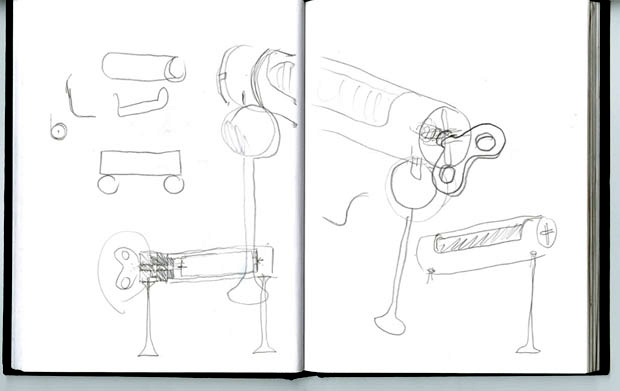
Daniel's sketches for the clock:


“Objects like clocks are both prosaic and profound,” says Weil. “Prosiac because of their ubiquity in everyday life, profound because of the mysterious nature of time itself. Time can be reduced to hours, minutes and seconds, just as a clock can be reduced to its component parts. This doesn’t explain time, but in a way simply exposes its mysterious essence.”

*

above: Daniel Weil. 'Radio in a bag', 1983. 28.5 x 20.6 c


above article and images via Pentagram